Many small contractors run successful businesses without ever developing a proper system for understanding their accounts. Money comes in, bills get paid, and if there is enough left over, the owner takes some out.
That might work for a while. But as the business grows, it becomes increasingly difficult to know whether the work is profitable, how much money needs to be retained in the business, or whether there is enough work coming in to cover future costs.
The answer is not necessarily more complicated accounting software or a large finance department. It is about developing your accounts in stages, so that each step gives you a clearer picture of how your business is performing.
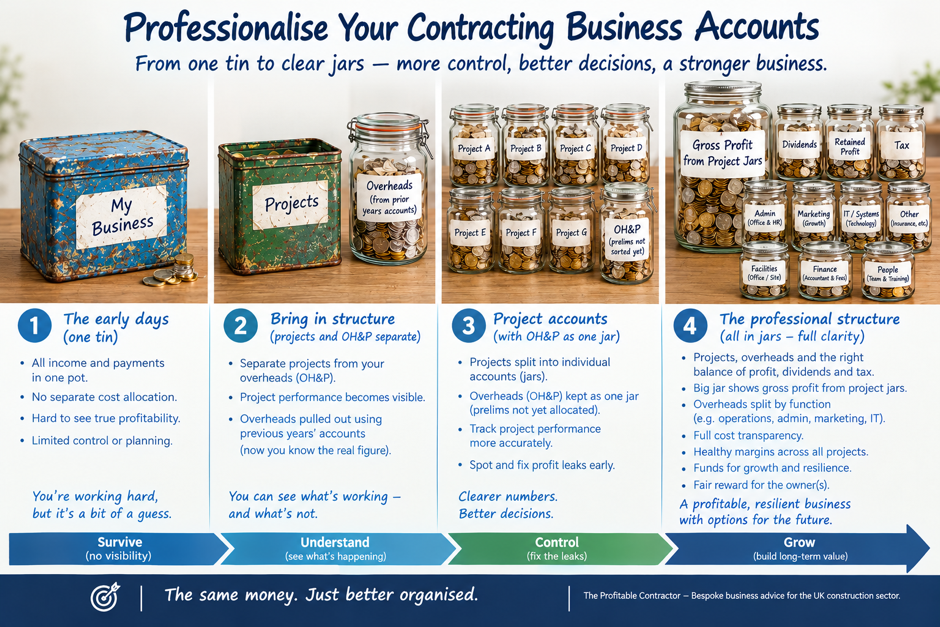
Think of it as moving from one biscuit tin to a series of jars where you can see how much there is in it. The money coming in and going out is broadly the same, but you gradually gain the ability to see where it goes and what it tells you.
Here are four steps to get there.
Step 1: Record the money coming in and going out
At the beginning, your accounts might be little more than a record of sales, payments received, bills paid and money taken out of the business.
Imagine putting everything into one biscuit tin. You know how much money has gone in and how much has come out, but you cannot easily see what is left for each purpose.
You might know that the bank balance looks healthy, but that does not necessarily mean the business has made a profit. Some of that cash might be needed to pay suppliers, meet tax liabilities, fund work in progress or cover bills that have not yet arrived.
Similarly, a busy order book does not guarantee that the business is making money.
At this stage, the owner may be taking substantial dividends whenever cash is available, without a clear picture of how much profit has actually been earned or how much should be retained.
The first step is simply to understand the difference between cash & profit and that there are variable and fixed costs. You do not need a sophisticated system to begin, but you do need accurate records and someone who can help you understand what they mean.
This is your starting point, not your destination.
Step 2: Separate out your overheads
The next step is to separate the costs of running the business from the costs of doing the work.
The money is still going into the same biscuit tin, but now you put the overheads into a separate jar.
Overheads are the costs you incur to keep the business operating, even when there is no work on site. They might include office costs, insurance, accountancy, estimating, marketing, management salaries and other general running costs.
Some costs are less straightforward. For example, vans might initially be included in overheads, even though they are used on particular jobs. That is acceptable as a starting point. As your system develops, you can decide whether these costs should be allocated to the relevant projects.
The immediate objective is to establish how much it costs to run the business.
Look at your previous accounts and calculate your overheads as a percentage of turnover. This gives you an initial indication of how much needs to be recovered through the prices you charge for your work.
For example, if annual overheads are £100,000 and turnover is £1 million, overheads represent 10% of turnover.
That 10% is the starting point for calculating the overhead allowance in your tenders. You must then add an appropriate amount for profit, say 5%.
There is an important qualification: last year's percentage is a starting point, not necessarily the right figure for your next tender. You need to consider expected turnover, changes in costs and the work you are likely to secure.
You should also understand the difference between markup and margin. They are not interchangeable, and confusing them can result in under-pricing.
For more detail, see Why confusing markup and margin could cost you £££££.
The benefit of Step 2 is clarity. You now have a better understanding of what it costs to keep the business running and a more informed basis for pricing your work.
Step 3: Introduce project accounts
Knowing your overheads is useful, but it still does not tell you whether individual projects are making money.
For that, you need to introduce project accounts.
In our analogy, you are adding another set of jars. The money is still the same, but you can now see which costs belong to which project.
Start with the basics: match the labour, plant and materials costs to the relevant jobs.
For each project, you want to understand what you expected to spend, what you have actually spent and how much work you have completed. As the system develops, you can compare the value of the work with the costs incurred and identify differences before they become serious problems.
This is particularly important in construction. A project can look busy, and the payments coming in can look reassuring, while the actual cost of completing the work is quietly increasing.
If labour is taking longer than expected, materials are costing more, or hired plant is staying on site unnecessarily, the information needs to reach the person managing the project while there is still time to act.
You do not need to implement every element of sophisticated project accounting immediately. Begin by capturing the direct costs reliably and making sure they are associated with the correct project.
Once you have that information, you can start to establish a meaningful project profit and loss account. You can also develop more detailed reporting, including cost value reconciliation (CVR), to compare the value of work completed with the costs incurred and the costs still forecast to complete the job.
For more on turning your accounts into a practical management tool, see Management accounts: the day-to-day accounts for business owners.
The benefit of Step 3 is that you can start to see which projects are making money and which need attention. That information can then improve future estimates, tendering decisions and project management.
Step 4: Refine your overheads and start managing the business
With overheads identified and project costs being recorded properly, you can begin to get much more from your accounts.
The next step is to break down the overheads into the functions of the business.
For example, you might separate the costs of estimating and winning work, project management, administration, premises and senior management. The categories will depend on the size and nature of your business.
Why do this? Because knowing that your overheads are 10% of turnover tells you something, but understanding what makes up that 10% tells you much more.
You can compare actual expenditure with your forecasts, identify where costs are increasing and decide where investment might improve performance. You can also examine whether your business has the right balance of resources to deliver its current workload and support future growth.
As your reporting improves, there are several other refinements worth considering.
Forecast revenue and overheads. Use the work already secured and the opportunities you are pursuing to estimate future turnover. Compare that with your expected costs to understand whether your business is likely to cover its overheads and generate the profit you want. Update the forecast regularly rather than waiting until the year-end accounts arrive.
Use preliminaries appropriately. Where costs relate to a particular project, consider whether they should be included in that project's price rather than absorbed into general overheads. This can give you a more accurate view of project profitability and help avoid recovering the same cost twice or failing to recover it at all. For more information see https://www.profitablecontractor.co.uk/blog/reducing-overheads-by-reallocation-of-costs-to-preliminaries
Review how you pay yourself. Dividends can be a legitimate and tax-efficient part of remuneration for company shareholders, but cash in the bank is not the same as distributable profit. Taking too much out can leave the business without the reserves it needs to cope with a difficult project, a quiet period or an opportunity to grow. Consider dividends alongside salary, tax liabilities, working capital and the need to retain profits. For more information about dividends see https://www.profitablecontractor.co.uk/blog/dividend-cover-striking-the-right-balance-for-smes
Introduce a regular plan, review and act process. Set targets, prepare forecasts, compare actual results against them and investigate significant differences. If costs are rising, work is being delayed or the expected pipeline is weakening, you want to know early enough to respond.
My article Management Accounts – Plan, Review, Act explains this approach in more detail. You may also find Forecast revenue and overheads to get ahead useful.
The benefit of Step 4 is that your accounts become a tool for managing the business, rather than simply recording what has happened.
The same money, but a much better understanding
Professionalising your accounts does not mean that more money suddenly appears in the bank. It means you develop the information needed to understand what has happened to the money you already have, what is likely to happen next and what you can do about it.
The four steps build on each other:
- Money in, money out: establish reliable records.
- Separate overheads: understand the cost of running the business and improve your tender pricing.
- Introduce project accounts: identify the costs and profitability of individual jobs.
- Refine and review: break down overheads, forecast performance and use the information to make better decisions.
You do not have to do everything at once. Start with the stage that best describes your business and develop the next level when you are ready.
The important thing is to move beyond relying on the bank balance and your instincts alone.
Better information can help you price work more confidently, spot problems sooner, retain the cash needed to operate and invest in growth, and build a business that is less dependent on you personally.
It can also help prepare the business for succession or a future sale, should that become your objective.
Need help taking the next step?
At Profitable Contractor, I help UK contractors develop a better understanding of their numbers and use them to improve the way they price, manage and deliver work.
You do not need to transform your accounts overnight. We can start with the information you already have, identify the most useful next step and build from there, at a pace that suits your business.
The aim is simple: to give you the information and confidence to run a more profitable, resilient contracting business.
Visit Profitable Contractor to find out more about bespoke business advice for the construction sector and contact me for a no obligation discussion about how I may help you transfer the numbers in the right boxes in a timely way, so that control is not lost. Peter.Searle@ba4cs.co.uk