Taking a holiday is an easy and practical way to test how well your business operates without you. If decisions are delayed, projects stall or customers insist on speaking to you, you have identified areas where the business depends too heavily on its owner.
By clarifying responsibilities, developing your team, improving financial information and establishing consistent ways of working, you make the business easier to manage.
These improvements also create the foundations for sustainable growth. You can concentrate on winning the right work, developing your people and making better commercial decisions, rather than spending every day dealing with routine problems.
Almost by coincidence, you are taking the first steps towards building a business that someone else could buy — or that you could eventually pass on as a legacy.
You may have no intention of selling. Perhaps you want to continue running the business for another ten years, or pass it on to a family member or trusted colleague. Either way, a business that can operate and grow without your constant involvement gives you more freedom today and more options for the future.
What makes a business attractive to someone else?
The same drivers of what make a business easy to manage are important when you come to sell, as it’s what the buyer wants.
1. A business that does not depend on the owner
If every important decision, customer relationship and commercial negotiation rests with you, a buyer is not simply buying a business. They are buying a business that needs you to keep it going.
Developing a capable team, delegating responsibility and establishing reliable systems reduces this dependency. Your holiday becomes a simple test: can the business continue to perform when you are not there?
2. Avoid putting all your eggs in one basket
A business can be vulnerable if it depends on one key employee, one major customer, one supplier or one source of work.
For a contractor, that might mean one customer accounting for most of the turnover, one estimator who holds all the pricing knowledge, or one contracts manager who knows how every project really works.
Reducing these dependencies makes the business more resilient and gives a potential buyer or successor greater confidence that it can continue operating if a key person or relationship changes.
3. Repeatable and profitable work
A healthy order book is important, but a buyer will also want to understand how the business wins work and whether it can deliver that work profitably and consistently.
A clear approach to selecting opportunities, pricing tenders, managing projects and reviewing costs helps turn success from something that depends on instinct and personal intervention into a repeatable way of working.
4. Reliable financial information
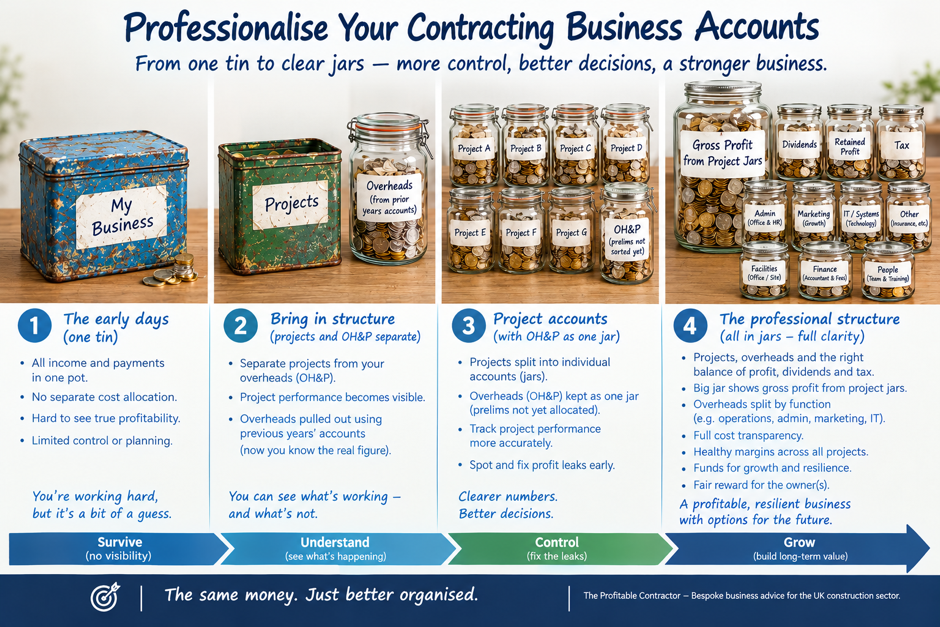
You need to know which projects make money, whether overheads are covered, how much cash the business requires and where problems are developing.
Regular management information allows you to make decisions based on what is happening now, rather than discovering the outcome after the year-end accounts have been prepared.
5. Working capital and cash flow
Construction businesses can be profitable and still run short of cash. You may have to pay wages, subcontractors and suppliers well before customers pay you. Retentions, delayed valuations, disputed variations and slow payment can make the position worse.
Working capital is the money tied up in keeping the business operating, including the timing difference between paying costs and collecting income. Understanding how much cash the business needs, and what causes that requirement to increase, is essential.
Better payment terms, timely applications for payment, effective credit control and accurate forecasting can release cash and reduce the need for additional borrowing. Good project controls also help identify when a growing workload is likely to create a funding problem.
This matters particularly when the business is expanding. Winning more work is not necessarily good news if you cannot fund the delivery of it.
A business that manages its cash requirements reliably is easier to run, better equipped to grow and more attractive to a potential buyer.
6. Sustainable growth
A business does not necessarily need to grow rapidly to become more valuable. But it does need to move forward.
If turnover and profits remain static while costs and prices rise with inflation, the business is effectively going backwards. Its purchasing power, capacity to invest and ability to reward its owner may all be eroded.
For a small contractor, steady, profitable growth above inflation may be a much better objective than chasing rapid expansion. This could mean winning a few more of the right jobs, developing existing customer relationships, improving margins or gradually increasing the team's capacity.
Growth should be planned and controlled. You need the people, systems, cash flow and management information to support it without creating unnecessary risk or making the business even more dependent on you.
A business that demonstrates consistent, profitable growth is better placed to offer opportunities to its employees, provide a future for a successor and attract a potential buyer.
How do the drivers affect the value of your business?
Ultimately, a buyer is interested in the profits a business can generate in the future, the risks involved and the cash required to support its operation.
One common measure is EBITDA — earnings before interest, tax, depreciation and amortisation. It provides a way of comparing the underlying operating performance of businesses, although adjustments may be needed to establish a sustainable level of earnings.
Business valuations often use a multiple of EBITDA. For example, if a business has maintainable annual EBITDA of £200,000 and an illustrative valuation multiple of four, the implied enterprise value would be £800,000.
That is an illustration, not a rule or a valuation of any particular contractor. The multiple depends on factors such as the quality and consistency of earnings, growth prospects, customer concentration, management capability, contractual risks and the wider market.
It is also important to distinguish enterprise value from the amount the owner ultimately receives. Debt, surplus cash and other transaction adjustments can affect the equity value, while the working capital required to operate the business is usually considered as part of the sale arrangements.
This is where the earlier drivers come together. A business with dependable earnings, sustainable growth, sound cash management and a capable team may be more attractive than one generating the same current profit but relying heavily on its owner.
You cannot guarantee a particular valuation multiple. But you can work on the factors that influence a buyer's confidence in the business and its future earnings.
Where do you start?
You do not need to tackle everything at once. Start by asking yourself:
- What decisions would stop being made if I were away for a week?
- Which people could take responsibility for those decisions?
- Do I know which jobs make money and how much working capital I need?
- Is my business growing profitably, and is that growth keeping ahead of inflation?
- How dependent am I on a small number of customers or key employees?
- If I wanted to sell or pass on the business, what would concern a potential buyer or successor?
The answers will help you identify where improvements would make the greatest difference.
At Profitable Contractor, I work with construction business owners to examine these drivers and develop a practical strategy to improve their businesses. That might mean improving pricing and margins, understanding the numbers, strengthening project delivery, managing cash flow, developing the team or planning for growth.
The support is bespoke. Some owners need help with one particular problem; others want to work through several areas over time. The objective is to agree the priorities, take practical steps and build a business that is more profitable and easier to manage — whether the ultimate goal is to enjoy greater freedom, support sustainable growth or prepare the business for sale or succession.
Your next holiday could be more than a break from work. It could be the first step towards building a business that works for you, grows in value and leaves a legacy you can be proud of. Please get in touch Peter.Searle@ba4cs.co.uk for a no-obligation discussion about how I can help you.